

‘Hoodwinked in the Hothouse: Resist False solutions to Climate Change’ is a near legendary zine in Climate Justice circles. Published in multiple languages and distributed to grassroots communities throughout the world, ‘Hoodwinked’ lays out just the essential facts on what technofixes and neoliberal financial schemes are false solutions that perpetuate systems of extraction and exploitation . The booklet helps to refocus activism towards real solutions for climate justice.
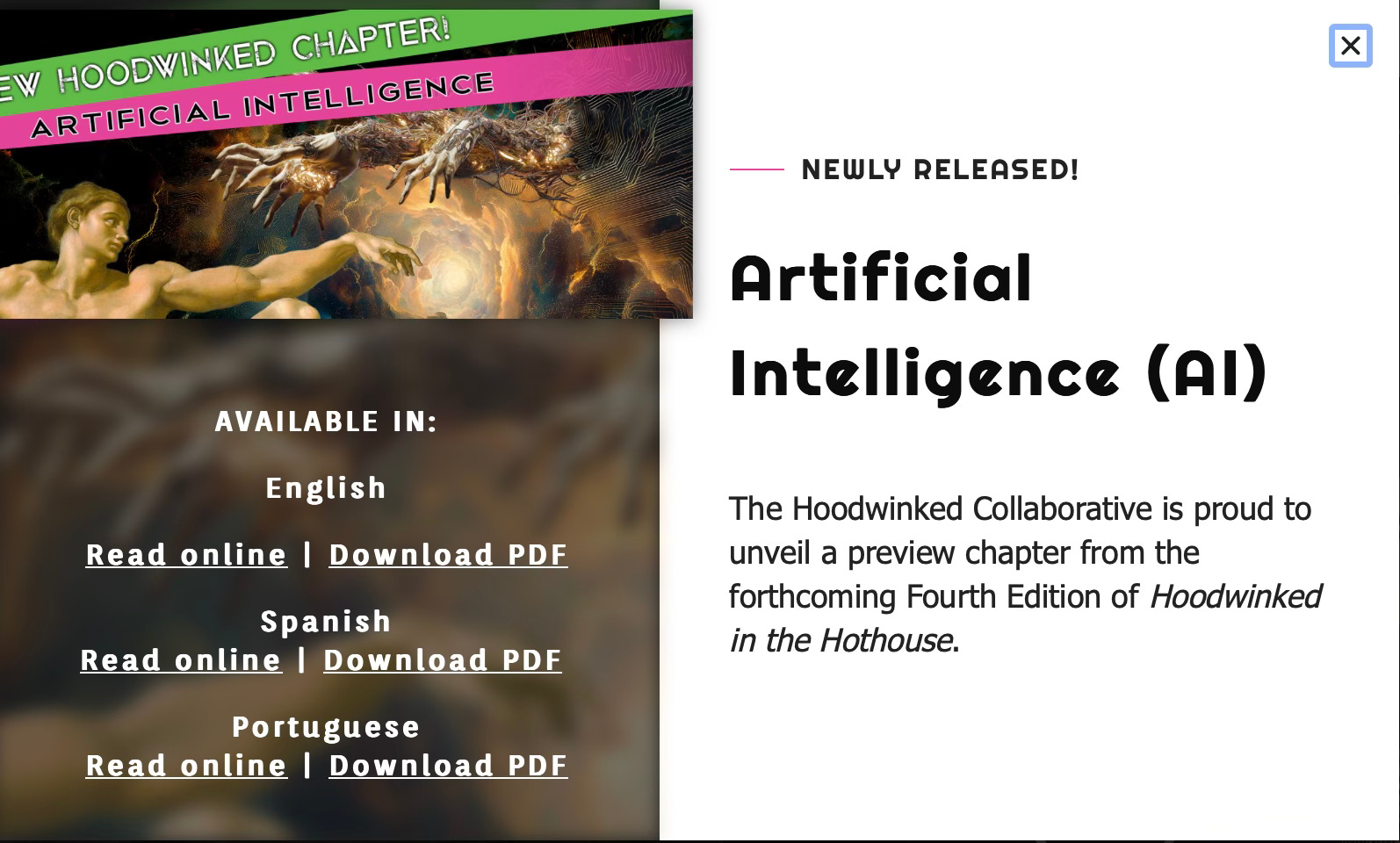
The fourth edition of ‘Hoodwinked’ is being finalized right now. As the global climate summit gets underway in Belem, Brazil, the Hoodwinked Collective have decided to pre-release the chapter on ‘AI as a false climate solution’ for movements to already print and use. I was honoured to be asked to write this short chapter for such a venerable and important publication. You can see or download the designed version of this new chapter here on the Hoodwinked website or just read the text below.
Please do share and use this short primer for popular education and activism. I also encourage everyone to read the full ‘Hoodwinked’ zine (currently available as its third edition but the fourth is imminent), order copies or donate to the collective to support this important resource.
Enjoy!
ps. For a refresher on different varieties of ‘false solutions’ you may also enjoy this article from two years ago.
AI as a False Climate Solution
written by Jim Thomas
In a world where students and scammers employ chatbots to cheat and deceive, it should be little surprise that greenwashers are selling artificial intelligence (AI) as a way to fake climate action. The world’s richest tech giants, such as Google, Meta, Microsoft and NVIDIA, are selling an “AI for climate” fantasy that prophesies their AI services concocting magical panaceas for the climate crisis. In reality, a massive speculative AI boom is fueling a huge increase in emissions, extraction and multiple harms across society.
What is AI?
Unlike the sci-fi version, today’s so-called “artificial intelligence” is not really “intelligent.” Computers analyze trillions of bits of data to produce responses a user may wish to see in an elaborate guessing game. Generative AI models (e.g., ChatGPT) calculate outputs that assemble “new” pictures, text or video using statistical trends gleaned from human-made writings and art (complete with built-in errors known as “hallucinations”). Trillions of dollars are being invested to build out AI infrastructure across the entire economy.
The Artificial Promise of “AI for Climate”
Can a chatbot save the climate? No, but Big Tech are creatively inventing scenarios in which AI might seem to shave the edge off climate emissions, including:
Air transport: Using AI to redirect the path of airplanes to prevent contrail formation and reduce fuel use.[1]
Industrial processes: Using AI to redesign manufacturing to use less energy or lighten materials.[2]
Digital agriculture: AI-directed industrial farming to increase storage of CO2 in soils or reduce fertilizer use.[3]
Novel proteins: AI-designed genetic engineering for new “alt-proteins” to replace meat or as enzymes for “greener” industrial chemistry.[4]
Materials: AI-designed materials for sequestering CO2 or replacing fossil-based materials.[5]
Like AI itself, these “solutions” are mostly error-riddled hallucinations.
1. Massive energy use: Digital technology has become an outsized user of energy with emissions higher than the aviation sector,[6] and those emissions are being supersized by AI computation. A typical AI data center consumes as much electricity as 100,000 households.[7] Data centers currently consume 1-2% of global energy – and this is expected to rise to 3-4% by 2030.[8] The electricity used by data centers runs computers and cooling fans but an additional matching amount is required to send data across networks and power devices. This energy demand is largely met by fossil fuels, extending the life of coal and gas plants. The AI boom is also justifying new investment in nuclear power. Microsoft recently signed a deal to restart the notorious Three Mile Island nuclear plant to help power its data centers.[9] Tech oligarchs are also investing in small modular nuclear reactors to help power AI.[10]
2. Water, minerals, pollution, noise: Data centers each require between 300,000 and 4 million gallons of water per day to cool overheating computers.[11] Even more water is used in electricity production. This deprives farmers and poor communities of essential water supplies, especially in Global South countries. The millions of racks of AI computers are constructed from mined minerals including silicon, gold, cobalt, nickel, copper and rare earths. Increased demand for these is driving land grabs, violent conflict and human rights abuse on Indigenous and peasant territories as well as additional climate emissions. The same components later become hazardous electronic waste. Data centers continuously run diesel generators causing significant local pollution and noise.
3. Doubling down on harmful industries: Many of the “AI for climate” schemes are about making already harmful industries more efficient and viable. Far from reducing harm, bringing efficiencies into such industries only encourages their growth. While AI boosters promise emissions reductions, the same companies are selling AI as a way to push up oil and gas production, expand industrial agriculture and intensify mineral extraction.
4. Oligarchs, militaries and surveillance: Imagined “AI for good” applications are dwarfed by the dangers of enabling corporate and military elites to control populations, workers and the economy. AI originated as a weapon of war and has become a defining feature of such conflicts as those in Gaza and Ukraine.[12] Its use depends upon surveillance, data collection, and theft of creative labor. Algorithmic bias and discrimination has been extensively documented as AI systems exacerbate racial, gender and other injustices.[13] In authoritarian countries (such as the U.S.) tech CEOs are now aligned with MAGA-style politics, enlisting AI to help dismantle social services, increase surveillance, imprison migrants and crush workers.
For More Information
Organizations:
Blogs and Podcasts:
[1] Elkins, C., & Sanekommu, D. (2023, August 8.) How AI is helping airlines mitigate the climate impacts of contrails. The Keyword. https://blog.google/technology/ai/ai-airlines-contrails-climate-change/
[2] Mehta, M. (2024, June 27). How manufacturing with AI can drive a sustainable future. World Economic Forum. https://www.weforum.org/stories/2024/06/how-manufacturing-with-ai-can-drive-a-sustainable-future/
[3] Rowe, J. (2025, January 6). Delivering regenerative agriculture through digitalization and AI. World Economic Forum. https://www.weforum.org/stories/2025/01/delivering-regenerative-agriculture-through-digitalization-and-ai/
[4] Graham, J. (2024, November 18). Q&A: Bezos Earth Fund CEO on how AI could help climate and nature. Context. https://www.context.news/nature/q-and-a-bezos-earth-fund-ceo-on-how-ai-could-help-climate-and-nature#
[5] Prest, J. (Host). (n.d.). Shaping the future of material design with AI (No. 2) [Video podcast episode]. In Energy Futures Podcast. Energy Futures Lab. https://www.imperial.ac.uk/energy-futures-lab/energy-futures-podcast/episode-2—shaping-the-future-of-material-design-with-ai/
[6] Lavi, H. (2025, July 17). Measuring greenhouse gas emissions in data centers: The environmental impact of cloud computing. Climatiq. https://www.climatiq.io/blog/measure-greenhouse-gas-emissions-carbon-data-centres-cloud-computing
[7] IEA. (2025). Energy and AI. IEA. https://www.iea.org/reports/energy-and-ai
[8] Goldman Sachs. (2024, May 14). AI is poised to drive 160% increase in data center power demand. https://www.goldmansachs.com/insights/articles/AI-poised-to-drive-160-increase-in-power-demand
[9] Sherman, N. (2024, September 20). Microsoft chooses infamous nuclear site for AI power. BBC. https://www.bbc.com/news/articles/cx25v2d7zexo
[10] See for example Oklo Inc backed by OpenAI founder Sam Altman.
[11] Mann, T. (2025, January 4). How datacenters use water – and why kicking the habit is nearly impossible. The Register. https://www.theregister.com/2025/01/04/how_datacenters_use_water/
[12] Férey, A., & de Roucy-Rochegonde, L. From Ukraine to Gaza: Military uses of artificial intelligence. Ifri.
[13] UNESCO, & IRCA. (2024). Challenging systematic prejudices: An investigation into bias against women and girls in large language models. https://unesdoc.unesco.org/ark:/48223/pf0000388971
Ugh do these people know AI has also led to wrongful incarcerations, people being denied healthcare and jobs, and is being used to surveil us all?!